
 25 years of the environmental voice in standards
As we enter our 25th year, we count nearly 50 experts and more than 60 member organisations from 30 countries across the world working together to support a healthy and clean environment, protected by robust rules that respect nature and its resources.
 New ECOS Strategy 2025-2030
We developed a new strategy for ECOS to ensure we are equipped for the many challenges we will face over the next five years.
Read more
We continue to emphasise the importance of inclusiveness in standardisation. We are connecting with more and more stakeholders at international, regional, and national level, and strengthening the voice of civil society in standards-making.
Read more
 Buy Better to Build Better
We have brought together over 30 stakeholders from across industry and civil society to demonstrate widespread support for green public procurement. Our continued efforts drive a positive change, embedding environmental ambition in Europe’s new competitiveness agenda.
Read more
 ECOS increases global reach with new Africa office
As part of our international strategy we opened a new ECOS office in Nairobi, Kenya to further develop partnerships with key regional players in standardisation and policy in the African region – including a Memorandum of Understanding with the African Organisation for Standardisation ARSO.
Read more
ECOS attends the UN Environment Assembly, UNEA, for the first time as an official observer, contributing to UN resolutions on topics ranging from chemicals to Artificial Intelligence. Our work now spans all levels of policymaking – from global environmental agenda setting and regional policy to its implementation via standards.
Read more
Our continued advocacy to expand the EU’s ecodesign framework to all products became a reality with the Ecodesign for Sustainable Products Regulation (ESPR). We pushed for an ambitious regulation and many of our positions were adopted.
Read more
We focus on standardisation priorities in support of EU environmental policies and legislation.
Read more
 EU adopts a common charger, a ‘global standard-setter’
The common charger makes waves across the world, it paves the way for product interoperability, helps consumers avoid unnecessary or redundant purchasing, and cuts down on e-waste
Read more
ECOS secretariat grows to more than 20 staff members. Our network is also expanding, counting over 50 experts and 51 member organisations across the world.
 ECOS officially becomes Environmental Coalition on Standards
We rebrand to ECOS - Environmental Coalition on Standards, with a fresh, modern look, fit for the years to come with our mission and brand reinforcing our outlook as an international environmental NGO.
Read more
The EN 4555X standard series will support the introduction of ecodesign requirements on material efficiency aspects such as repairability, durability or recyclability for a number of products, including fridges, dishwashers and washing machines.
Read more
 Our work area portfolio continues to expand
We launch new programmes on construction, textiles, and sustainable finance.
Our influential report on applying ecodesign principles to plastic will later push the EU to decide to introduce ecodesign in more sectors, such as textiles and construction – going beyond energy-using products and building the foundation of the future Ecodesign for Sustainable Products Regulation (ESPR)
Read more
 First advocates for a universal right to repair
As co-founders of the Right to Repair Europe coalition, we work to remove the barriers to repairing our products. We also play a critical role in shaping the ‘repair standard’.
Read more
ECOS joins forces with CEN-CENELEC, ANEC and ETUC in developing a free interactive online course on standards and standardisation processes.
Read more
 We shape an ambitious
Our technical input at every stage of the process was vital to raise the ambition of the new ecodesign rules, which will lead to more efficient, repairable and durable appliances.
Read more
 With the launch of the AccESS project, we undertake unprecedented efforts to support our members’ participation in standardisation.
 The new Energy Labelling Framework Regulation includes points on label rescaling and anti-circumvention, for which we heavily campaigned.
Read more
The standard specifying cement composition will be supplemented to include lower-carbon cements - a driving force for increased demand for greener alternatives.
Read more
Reiterating our commitment to work together with other stakeholders to improve the European Standardisation System and reinforce societal stakeholders’ participation.
 Following the EU’s first Circular Economy Action Plan, we launch a new long-term programme on plastics and become part of the Break Free From Plastic movement.
Read more
…thanks to our work on the Vademecum for European standardisation.
After years of standardisation work, ECOS welcomes the adoption of ISO 13065, to date the most comprehensive sustainability reporting framework for bioenergy.
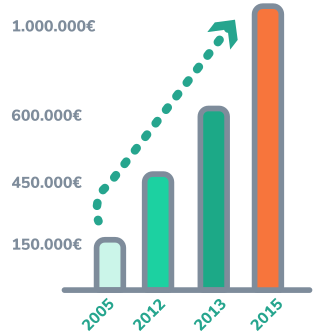 As we demonstrate more and more tangible results, we start to increasingly push our technical expertise into the policy area, making links between policy and standardisation to deliver even more impact.
 ECOS is recognised as a so-called Annex III organisation - we represent environmental interests in standardisation. The EU Standardisation Regulation gives us the right to participate in all European Technical Committees.
Our advocacy for natural refrigerants will lead to important successes such as a new standard that will allow larger quantities of climate-friendly alternatives to damaging fluorinated gases in commercial refrigeration.
Read more
We help ensure that the transposition of the Energy Performance of Buildings Directive to national levels is based on a common language and robust methodologies.

A breakthrough after seven years of campaigning, the regulations were finally approved. Gradually applied from 2015, they have enabled CO2 emissions savings of approx. 20 Mt in 2020.
The European Union decides to officially facilitate the engagement of underrepresented stakeholder groups – making room for an environmental voice at the table where standards are developed.
 We become co-leaders of a new coalition of environmental NGOs working to ensure that ecodesign and energy labelling truly work for Europeans and the environment. Coolproducts made energy-using products more sustainable for nearly two decades.
Read more
We become co-leaders of a new coalition of environmental NGOs working to ensure that ecodesign and energy labelling truly work for Europeans and the environment. Coolproducts made energy-using products more sustainable for nearly two decades.
Read more
 Thanks to our active involvement, IEC votes against a standard allowing toxic chemicals. Our work will later contribute to the exclusion of flame retardants from other standards by IEC & CENELEC.
Read more
 Ecodesign and energy labelling legislation is still a key focus today – helping ECOS become an influential NGO, pushing for better products through ambitious standards, policies and laws.
More members join our network, bringing us to 16 in total and making the environmental voice in standardisation stronger.
An important work area to this day, Life Cycle Assessment ensures a better understanding of the environmental impacts of products at all stages of their lifecycle.
 ECOS contributes to the first revision of the ISO standard on Environmental Management Systems, which paves the way for companies to uphold their environmental responsibilities.
Read more
 ECOS is accepted as an Associate Member of the European Committee for Standardization (CEN) and is granted its first observer role in the European Committee for Electrotechnical Standardization (CENELEC) working group on Environmental Standardization.
 Founded by EEB, WWF Europe, Friends of the Earth Europe, BirdLife International, Danmarks Naturfredningsforening and France Nature Environnement, we start our work as a technical NGO tasked to defend environmental interests in standardisation. Our small team works closely with a network of experts, translating environmental thinking into technical language.
ECOS is co-funded by the European Commission and EFTA

 Funded by the European Union. Views and opinions expressed are however those of the author(s) only and do not necessarily reflect those of the European Union or EISMEA. Neither the European Union nor the granting authority can be held responsible for them.