
The European Commission’s recently unveiled Circular Economy Action Plan presents a renewed commitment to a transition towards more sustainable production and consumption.

The Alliance for Flame Retardant Free Furniture welcomes the New Circular Economy Action Plan and calls on the EU institutions to address the unnecessary and unwanted use of chemicals which prevent circularity and climate goals, such as toxic flame retardants in furniture. They directly endanger people’s health, as they migrate out of products and may lead to an increase in fire toxicity.

We are still awaiting the regulatory way forward after a proposal by industry on a water label for taps and showerheads received criticism from the majority of Member States and other stakeholders at the Consultation Forum in December last year. Meanwhile, the European Commission has approached European Standardisation Organisations with the final draft Standardisation Request for the development of measurement methods for these products.

At the beginning of April, we communicated our position against the expansion of the scope of ISO Technical Committee 300 on Solid Recovered Fuels (SRF).
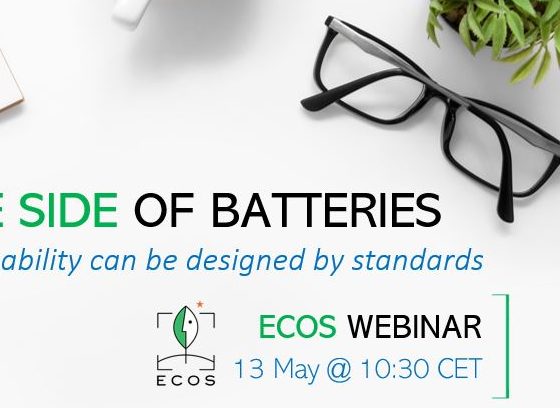
Do you think it is time to design batteries that are truly sustainable? Did you know that standards can make this happen? Watch our webinar to learn more!

On behalf of the STAR-ProBio project partners, we would like to invite you to an online workshop entitled “Assessing Sustainability of Bio-based Products: Where do we stand?”.

The implementation of the tethered caps requirement for beverage containers under the Single Use Plastics Directive has been quite cumbersome for the European Commission. After a first failed attempt at agreeing on the working mandate for standardisers, CEN now seems happy with the new version of the Standardisation Request presented by the European Commission for consultation at the end of March.
ECOS is co-funded by the European Commission and EFTA

 Funded by the European Union. Views and opinions expressed are however those of the author(s) only and do not necessarily reflect those of the European Union or EISMEA. Neither the European Union nor the granting authority can be held responsible for them.