 By
By
ECOS and 15 other NGOs have signed a letter calling on Energy Ministers of EU Member States and representatives to support a more ambitious EPBD at the Energy Council next 27th of June.
In March, the European Commission presented an ambitious package of regulatory proposals to implement its Circular Economy Action Plan. The proposal for a Regulation on Ecodesign for Sustainable Products (ESPR) extends ecodesign to a broad range of sectors, including textiles and construction products, finally addressing negative environmental impacts embedded in products by design. However, work needs to be done so that the package lives up to its full potential.

Members of the European Parliament's Environment and Economic Affairs committees have voted against including gas and nuclear energy in the EU Taxonomy. The vote is an encouraging step in the right direction to save the credibility of the EU Taxonomy Regulation.

 By
By
‘Carbon neutral’, ‘CO2 neutral’, ‘climate friendly’, ‘climate neutral’… As potentially misleading marketing messages spread like wildfire, policymakers and standardisers are trying to introduce rules that avoid massive greenwashing. In Europe, the Commission is launching new regulations; at the global level, ISO is developing a new standard on carbon neutrality. Will these initiatives be fit to solve the problem? Mélissa Zill, ECOS programme manager, explains why these plans might in fact end up missing the mark.
 By
By
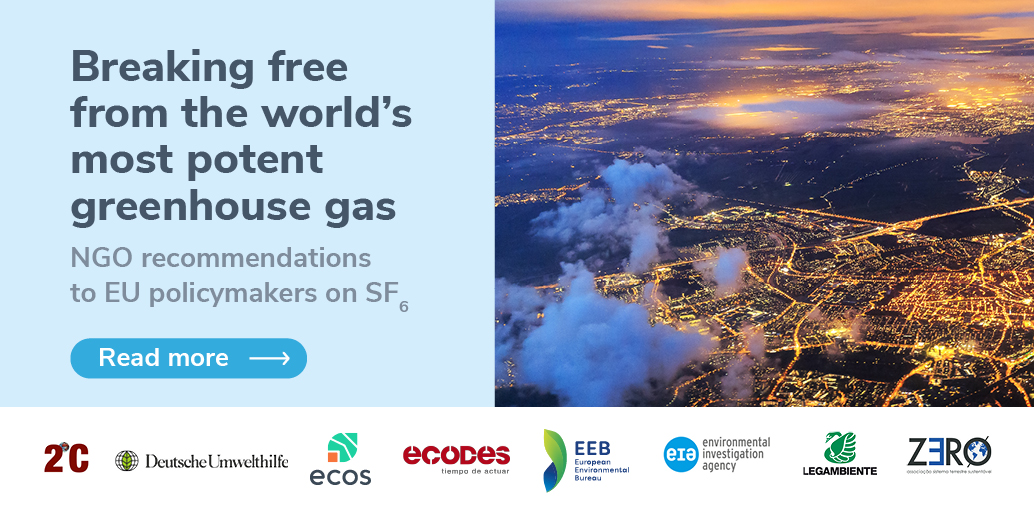
Sulphur hexafluoride (SF6) is used in electricity grids as an insulating gas in high- and medium-voltage switchgear. It is the world’s most potent greenhouse gas with a global warming potential (GWP) 25,200 times greater than CO2 over a 100-year period. Eight NGOs call on the European Union to introduce an early phase-out of SF6 as part of the revision of the F-Gas Regulation.

 By
By
The proposal to include nuclear energy and fossil gas in the EU Green Taxonomy caused uproar across Europe earlier this year. Why? Because this proposal affirms that nuclear energy and fossil gas should be labelled as sustainable investments, when in reality they are not ‘green’ and should not be labelled as such.
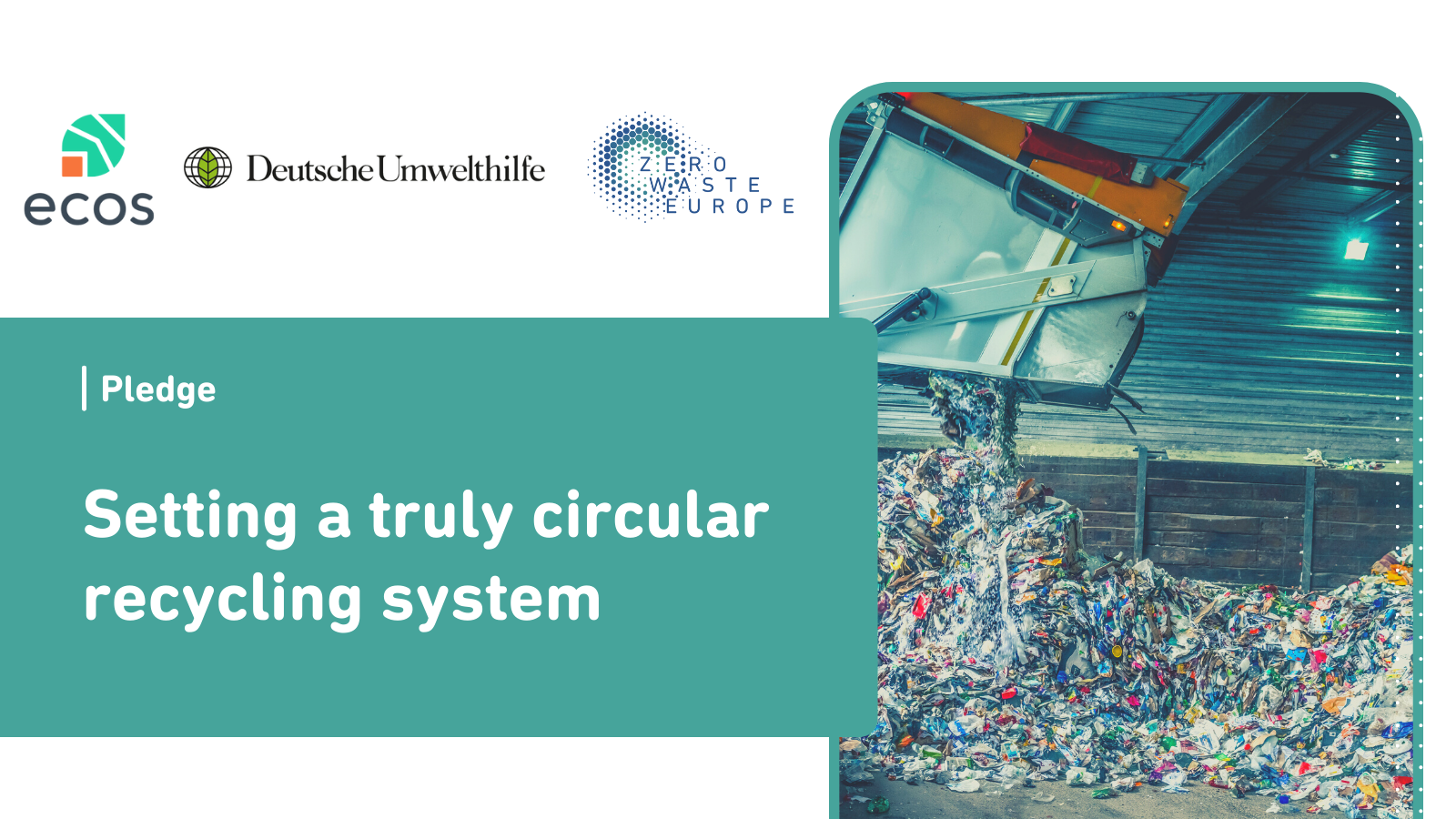
ECOS co-signs a pledge on chemical recycling with Zero Waste Europe and Deutsche Umwelthilfe (DUH), calling for circular economy principles for plastic. We encourage civil society and recycling industry organisations to endorse these principles.
ECOS is co-funded by the European Commission and EFTA

 Funded by the European Union. Views and opinions expressed are however those of the author(s) only and do not necessarily reflect those of the European Union or EISMEA. Neither the European Union nor the granting authority can be held responsible for them.