 By
By
The European Commission is circulating a proposal in which nuclear energy and natural gas would join the EU Taxonomy – an official list of investments considered ‘environmentally sustainable’. In an opinion report published this week, experts from the Platform on Sustainable Finance question whether this is in line with EU law. Why? ECOS Senior Programme Manager and Platform member Mathilde Crêpy explains.

2022 has the potential to be a critical year for environmental policy, with a focus on international climate action, negotiations for a global treaty on plastics, making sustainable products the norm, and leveraging environmental policy as a key tool of the economic stimulus following the COVID-19 pandemic.
 By
By
ECOS seeks to subcontract national support to ECOS policy and standardisation work on zero carbon cement & concrete, in the following countries: France, Germany, Denmark, Belgium, Sweden, and Portugal.
 By
By
We are looking for a Communications & Public Relations consultant to support the work of a newly-created zero-carbon cement & concrete coalition. Progressive actors will join efforts to help secure an ambitious and effective decarbonisation pathway for the cement and concrete (C&C) value chain, targeting (nearly) zero-carbon by 2040 through policy and standards work.

We are looking for a highly motivated Administrative Officer to join our Operations team, and support the smooth running of the organisation. Reporting to the Operations Director, the Administrative Officer will support and manage multiple initiatives relating to HR, administration, office management, grants and finances.
We are looking for a highly motivated Programme Manager to join our team and reinforce our engagement in the development of policy and standards to improve the sustainability of the ICT sector.
 By
By
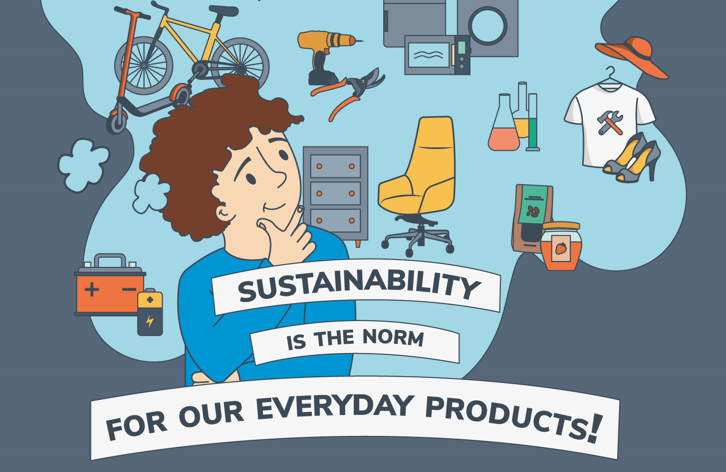
In 2022, The European Commission will launch its Sustainable Products Initiative. Through minimum requirements on circularity, digital product passports, and other new rules, this framework can potentially make sustainable products not an exception but the norm. We imagined how the SPI could change our lives through three everyday situations – what would a future of sustainable products look like?
ECOS is co-funded by the European Commission and EFTA

 Funded by the European Union. Views and opinions expressed are however those of the author(s) only and do not necessarily reflect those of the European Union or EISMEA. Neither the European Union nor the granting authority can be held responsible for them.