
Petrochemicals need defossilisation as much as decarbonisation
 By
By  By
By  By
By Most of our daily lives have come to rely on petrochemical products: plastic packaging, car parts, building materials, synthetic clothing, electronics, paints, detergents, medical equipment… the list goes on. The industry brands itself as the “mother of all industries” for a reason: it sits behind countless products and value chains. And the climate footprint is massive.
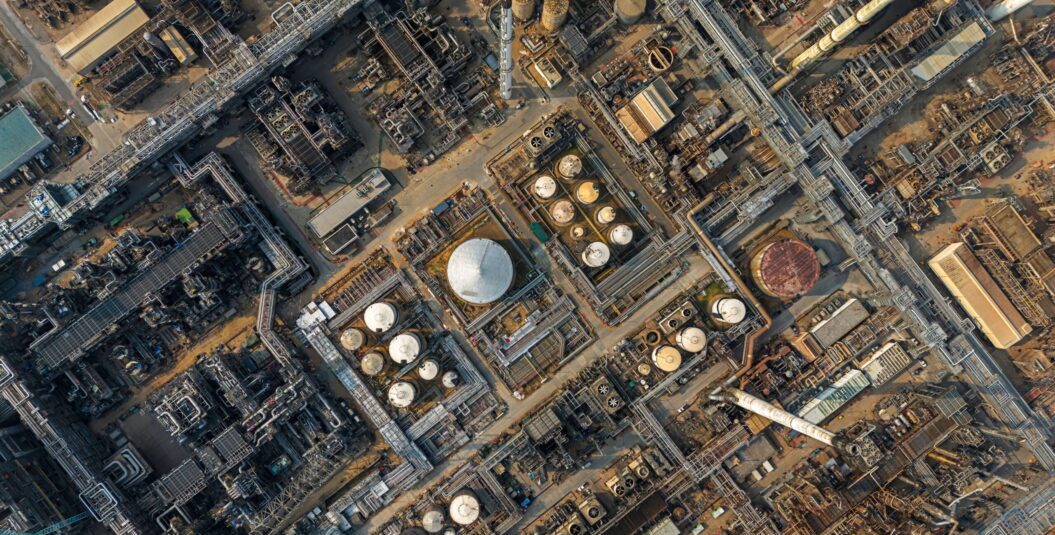
Petrochemicals are everywhere, and so is their footprint
A 2022 review by Lund University and ETH Zürich estimated that direct emissions from petrochemical production reached 1.8 billion tonnes of CO2 in 2020. That already equals 4% of global greenhouse gas emissions but only scratches the surface. Once you include emissions from industries supplying inputs to petrochemicals, emissions reach an estimated 5.6 billion tonnes of CO₂ equivalent, or around 10% of global greenhouse gas emissions. That is still before accounting what happens after products are sold and used, such as incineration, degradation, and disposal.
Petrochemicals are the largest industrial consumer of energy. The sector accounts for around 15% of global oil demand and 8% of global gas demand, including both energy use and feedstocks. Combined, this is around 50% more than iron and steel. This is why the sector cannot be understood only through factory emissions. Its true footprint comes from energy use, fossil feedstocks, and the products that eventually become waste.
What are petrochemicals? From feedstocks to everyday products
Petrochemicals turn feedstocks (hydrocarbons, molecules made of hydrogen and carbon) into the chemical building blocks used across the economy.
Steam crackers are the most common production route. In Europe, steam crackers typically use naphtha as feedstock, an oil-derived product from refineries. Inside the steam cracker furnaces, feedstocks are mixed with steam and heated to around 850°C until the molecules split, or “crack”, into shorter and more chemically versatile ones including ethylene, propylene, and butylenes. All of which are part of a family called olefins.
These are not products most people recognise in daily life but building blocks for familiar products such as plastic packaging, synthetic fibres, insulation, car parts, pipes, and much more.
The challenge: petrochemicals are not just an energy problem
Decarbonising petrochemicals is tough. Renewable energy can solve part of the problem, but it cannot remove the fossil carbon built into the products themselves. That is because most chemical sector emissions sit outside of production in scope 3 emissions, or indirect emissions across the value chain, from the raw materials and feedstocks used to make chemicals to the end-of-life treatment of the products they become. These are estimated to go beyond more than half of the total footprint.
That is why petrochemicals need more than decarbonisation. They also need defossilisation. Decarbonisation cuts emissions from energy use and production processes. Defossilisation means replacing virgin fossil carbon as the feedstock for chemicals and plastics with non-fossil alternatives. A credible transition needs both: cleaner production and a shift away from fossil raw materials.
The policy moment: Europe is starting to look at the sector
The petrochemical industry has received far less public scrutiny than other heavy industries, such as steel and cement. That is beginning to change. Recently, the sector has moved higher up in the EU political agenda through initiatives such as the Critical Chemicals Alliance. But more attention does not automatically mean better policy.
Instead, the debate is being shaped by the industry’s complaints: not enough investment, high energy costs, trade pressures, and the perceived burden of chemical, environmental and worker protection rules. These issues matter, but they do not tell the whole story.
As fossil fuels face growing pressure in energy markets, petrochemicals offer oil and gas companies a backup plan for fossil carbon: not to burn, but to turn into materials. A credible European chemicals agenda must also ask how the sector will cut emissions, reduce demand for virgin fossil feedstocks, and stop treating petrochemicals as a growth market for oil and gas.
What credible transition pathways look like, and what their limits are
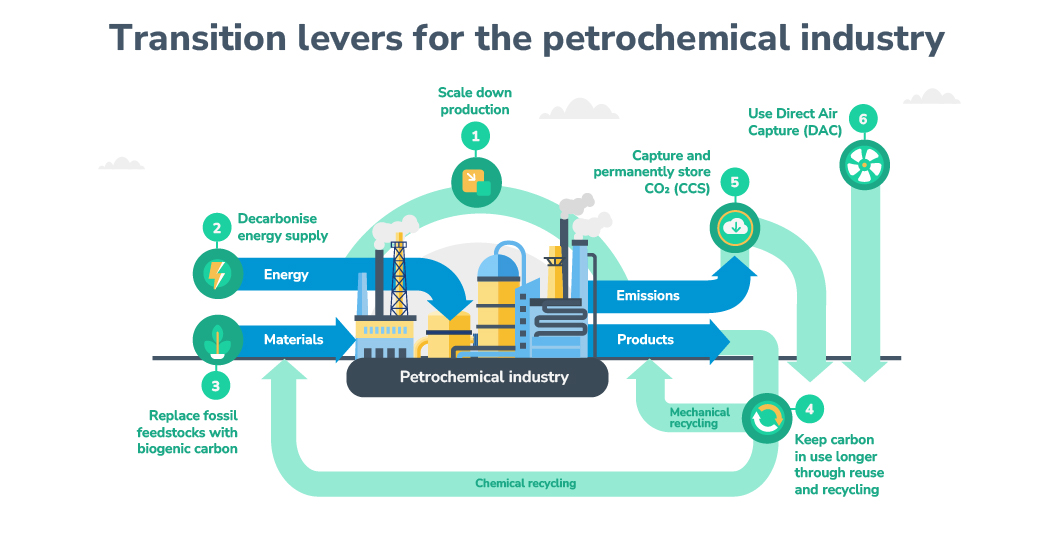
A transition will not happen overnight, and there is no silver bullet – but a transition is necessary. There are six levers showing the way out of the current, heavily polluting fossil-carbon model. None of these pathways on its own can bring the chemical industry to net zero emissions. But they can – and must – in combination.
- Scale down production to align with actual demand;
- Decarbonise energy supply by replacing combustion-based furnace heat and steam generation with renewable electricity;
- Replace fossil feedstocks with biogenic carbon, meaning carbon from biomass, within strict limits on what can be produced sustainably;
- Keep carbon in use for longer through reuse and recycling, prioritising mechanical recycling over chemical recycling where it preserves material quality;
- Capture and permanently store CO₂ through carbon capture and storage (CCS);
- Use Direct Air Capture (DAC) to remove the equivalent of unavoidable carbon dioxide emissions from the atmosphere.
These levers are not equally scalable or sustainable. Reducing unnecessary production, decarbonising energy supply, and replacing virgin fossil feedstocks in a sustainable way should be a default starting point. Other approaches, such as CCS and DAC, have a limited role in addressing emissions that are difficult to avoid.
Europe’s challenge is not only to keep a chemical industry, but to ensure that public policy supports the chemicals we need. And those chemicals must be produced within health, climate and planetary limits. Competitiveness cannot be an excuse for fossil carbon lock-in.

