We are making smart devices more flexible
Demand-side flexibility is a key ingredient of the EU’s energy transition, making widescale electrification a reality by coordinating how and when large devices such as heat pumps, electric vehicle batteries (and their chargers), solar panels, and stationary batteries use the most electricity. ECOS advocates for the best tools to help protect the grid, unlock energy savings, and maximise the use of renewables.
The EU must electrify with renewables as fast and as much as possible to kick its unhealthy reliance on fossil fuels. Electricity grids need to be upgraded and expanded when necessary, to be able to transport all this electricity – but that takes time. Other solutions need to be rolled out simultaneously, including tools to use electricity in a more flexible way, such as demand-side flexibility. Our work informs EU policymakers and other stakeholders how to do this effectively.
Demand-side flexibility
When connected to a flexible energy management system, large devices like heat pumps and electric vehicle (EV) batteries and their chargers can adjust their electricity use to support the grid, only consuming electricity when ample renewable energy is available or when demand for electricity is low – and even storing it for later use. This is called ‘demand-side flexibility’, and it is crucial for the energy transition. It helps to avoid energy use at peak demand, and ensures Europe makes the best use of the grids it already has.
Unlocking flexibility, one standard at a time
Alongside renewables, demand-side flexibility is accepted as a key component of the EU’s energy transition, but it needs to be implemented in a future-proof and interoperable way to have a real impact. Smart devices must be flexible throughout their lifetimes, with as few hiccups as possible. This is currently not the case. Just because a device is smart does not mean it is fully flexible – but with the right tools, it can be. So, what are the right tools?
For smart energy appliances
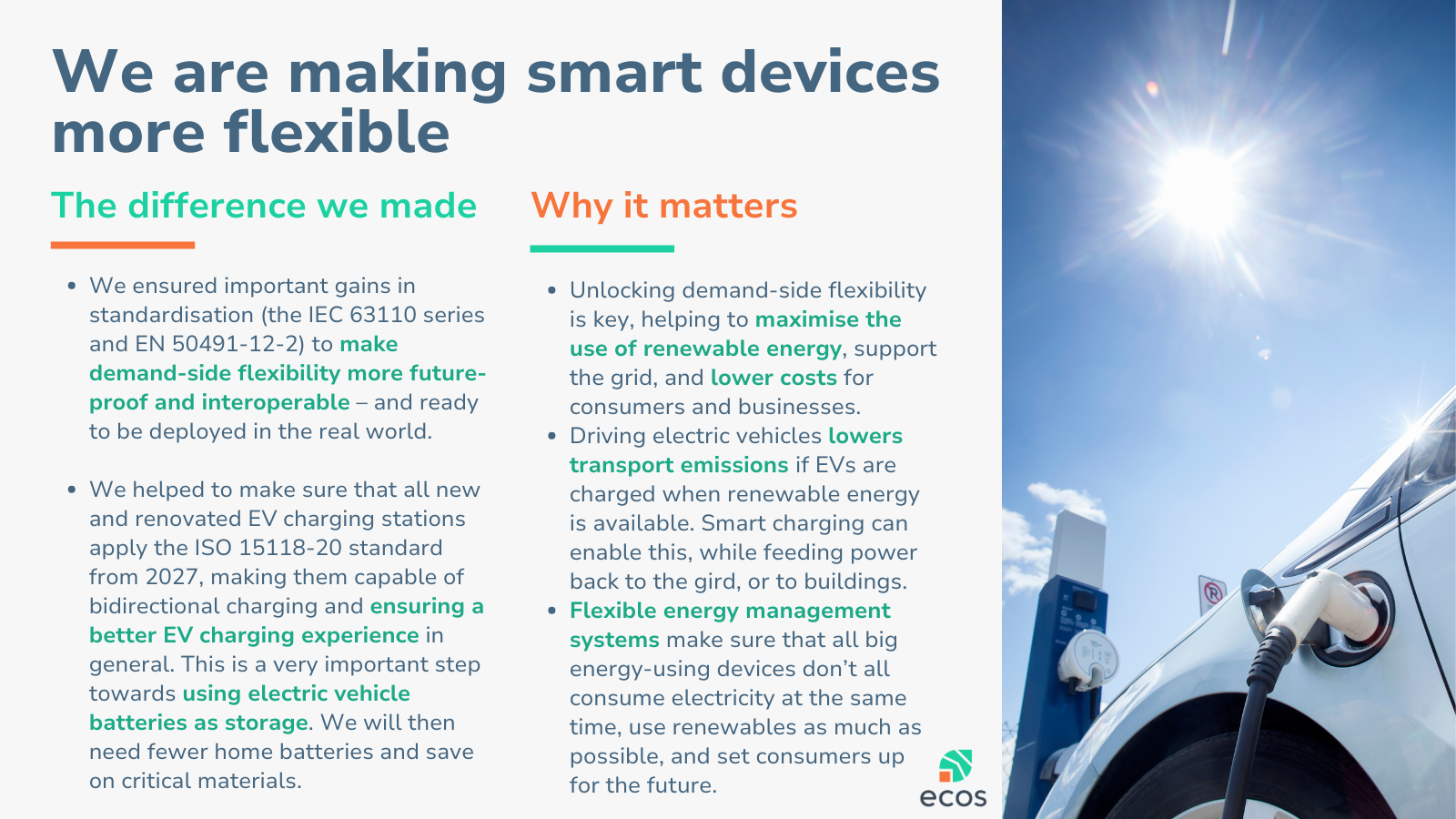
Standards help to ensure different manufacturers of smart energy appliances in buildings follow the same rules when it comes to managing energy. But not all standards offer the same level of effectiveness; some are more future-proof and can unlock more energy efficiency than others – for example, the European S2 standard (EN 50491-12-2), which ECOS was heavily involved in shaping. We contributed to the technical meetings where the standard was drafted, focusing on the smooth integration of electric vehicle charging into the general energy management of a building.
The S2 standard is the only approach on the market that is truly future-proof. It is the best way to ensure that devices can use energy smartly and flexibly. It is simple, it prioritises the needs of the electricity system in all possible current and future contexts, and it leaves manufacturers free to decide how they implement it.
Thanks to the support of ECOS and our partners, S2 is now widely known and considered to be one of the standards energy management and heat pump companies will choose to implement in the future to make their products smart. We raised awareness towards manufacturers about the benefits of S2, ensuring it was not overshadowed by the marketing efforts for other suboptimal standards. We also engaged with regulatory initiatives of the European Commission, aiming to get the standard included in relevant measures, including the voluntary Code of Conduct for Smart Energy Appliances Interoperability (CoC). S2 is not yet part of the CoC but could be very soon. This is a big change from a few years ago when the positive impacts the standard could bring about were not universally recognised, and we are happy to have played an instrumental part in this process!
For electric vehicle chargers
Standards are also used to help make EVs and the charging stations they communicate with more reliable – but making sure they work, is key.
Drafting took place simultaneously on two such standards: The Open Charge Point Protocol (OCPP) and the IEC 63110 series. However, because these standards have the same scope, the standardiser, IEC (International Electrotechnical Commission), had to choose which to take forward when OCPP applied to become an IEC standard. IEC selected OCPP, making the more robust IEC 63110 series obsolete. To ensure the important learnings from IEC 63110 were not lost, we compared the latest versions of the two standards, highlighting what needed to be carried over to OCPP to make it better.
Our work helped to make sure that good practices learned during the development of IEC 63110 were not lost, and this was well-received by EU policymakers. We also contributed to ensuring that the OCPP standard was not mandated by law before being good enough.
Towards a smarter future
Electrification is essential for the EU’s energy transition, and we are helping to make it faster, stronger, and more sustainable by promoting the right tools and unlocking demand-side flexibility with a real impact.

