Access granted? An inclusive approach to standards-making
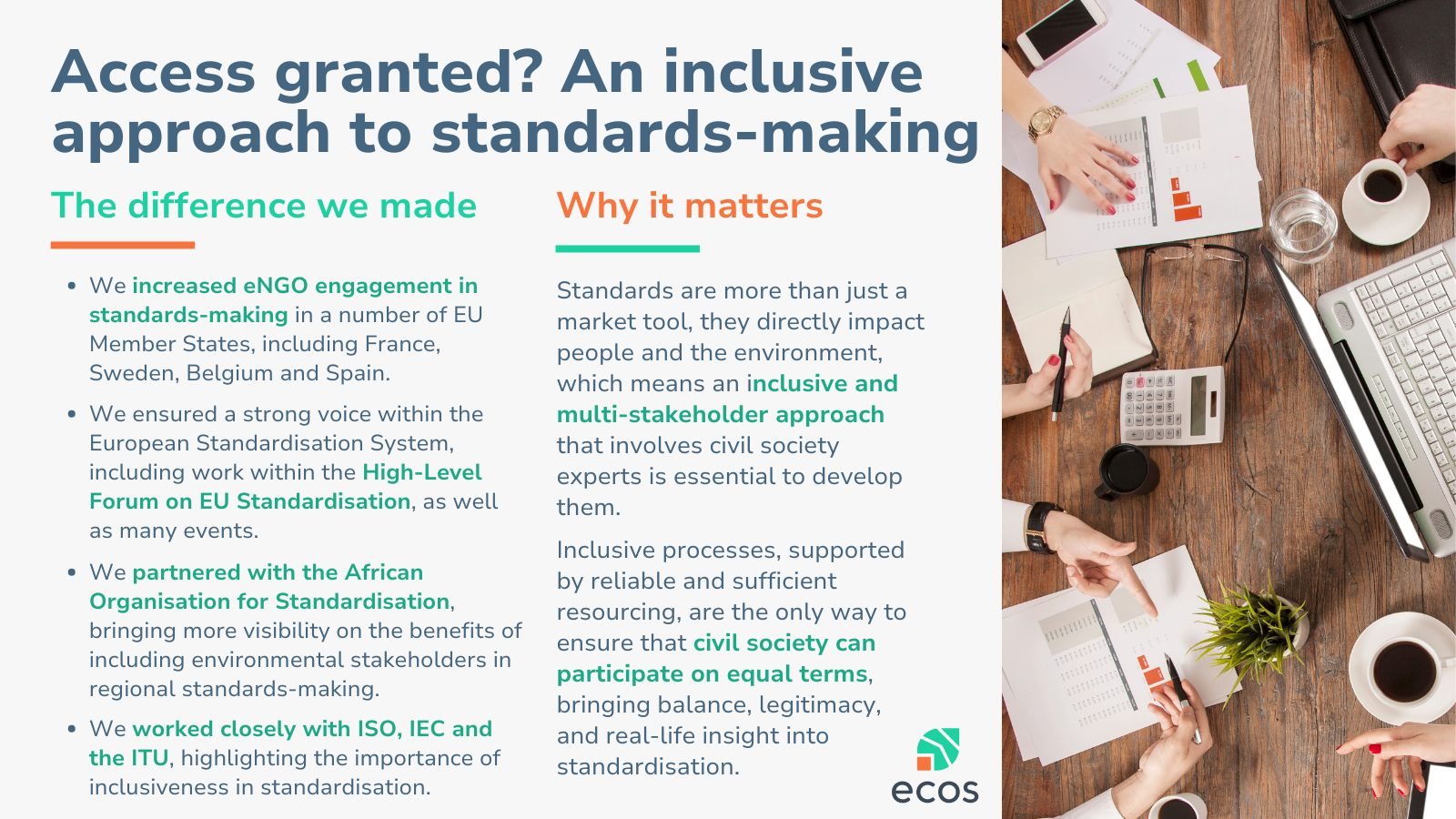
Standards directly impact people and the environment. A climate neutral, resilient, and circular economy will not happen without standards developed in an inclusive way, with environmental stakeholders at the table. In 2025, we further emphasised the importance of inclusiveness in standardisation, connecting with more and more stakeholders at international, regional, and national level, and strengthening the voice of civil society in standards-making.
For greater impact in national standardisation
National standardisation is the entry point into regional and international standards. A more balanced representation at national level would have a knock-on effect within the regional and international standardisation levels – something ECOS has been advocating since its very inception, and 2025 brought important progress in a number of countries.
Following our 2024 workshop on standardisation and environment, co-hosted in France with our member Ethikis, we facilitated discussions with French environmental NGOs, as well as the French Ministry for Ecological Transition to share best practices of inclusiveness in national standardisation from across our network. Our inclusiveness toolkit, published in early 2025, provided a handy framework for these crucial exchanges, which ultimately led to the Director of our member organisation HOP being appointed to the Board of AFNOR – the French National Standardisation Body, with dedicated funding from the French Ministry for Ecological Transition to enable HOP’s effective participation.
But France was not our only focus. We increased national activity in standardisation by co-hosting a similar workshop in Sweden together with our member SSNC, helping our network connect with their relevant NSBs and Ministries.
We also worked very closely with members from Belgium and Spain, always with the aim of unlocking possible funding opportunities from national authorities for environmental expert involvement, and providing guidance on how to engage in standards-making in a meaningful way.
In Belgium, in close cooperation with members and partners, we worked to improve access of civil society to the Belgian National Standardisation Body NBN. Thanks to our joint efforts, as of January 2026, environmental NGOs, consumer organisations, and trade unions will be able to participate in the work of NBN for free, removing an important barrier for civil society.
Finally, we have also ensured that our members were informed about the opportunities and risks arising from the revision of the EU Standardisation Regulation, and their importance for the inclusiveness of the European Standardisation System.
Europe is ahead on inclusive standards — with further improvements within reach
European standardisation is a key instrument for strengthening the EU Single Market. The European Commission uses technical standards to underpin legislation and provide presumption of conformity to EU law, and therefore market access. Essential legal requirements are defined in regulations, and standards define specifications for products, production processes, services, or test-methods.
In 2025, ECOS ensured a presence and strong voice within the European Standardisation System. We were part of many events, including a webinar and a high-level roundtable, co-hosted with the European standardisers CEN and CENELEC, as well as colleagues from organisations representing societal stakeholders and SMEs in the system, ANEC, ETUC and SBS. Focused on dialogue and collaboration, these events did a great deal to promote the need for inclusive standards.
Throughout the year we also engaged with a great number of actors involved in standards-making, and discussed ways to improve inclusiveness in European and international standardisation. Within the High-Level Forum on EU Standardisation, we actively shared our expertise and diverse experience, calling for EU societal stakeholders to be included at all levels of standardisation, from national to European to international.
Focus on regional standards in Africa
Thanks to our unique expertise, vast experience in the field and the ECOS Africa office in Nairobi, we are now present in crucial discussions around standardisation processes in the African region, too. In 2025, we spoke at various events to share topical lessons learned and create more visibility on the benefits of including environmental stakeholders and civil society in standards-making.
We worked closely with the African Organisation for Standardisation (ARSO), for example jointly celebrating the 2025 African Day of Standardisation. We were also invited to speak at the ARSO General Assembly on a panel on renewable energy, sustainability standards, and certification – our first opportunity to directly engage with African national standardisation bodies and other regional standardisation organisations on a continental platform.
Bringing inclusiveness to the forefront of the international stage
We need global commitments to tackle global environmental challenges. International standardisation is an important mechanism for facilitating global trade, including in environmental goods and services. Many products are sold across international markets, making harmonisation of product characteristics and test methodologies around the globe beneficial, especially for industry, but also consumers.
The standardisation system operates on an ‘international first’ approach to avoid barriers to international trade, meaning standards are – preferably – developed internationally and then adopted at national or regional level.
This is why in 2025 ECOS worked with ISO, IEC and the ITU, highlighting the importance of inclusiveness in standardisation, and promoting actions that will ensure meaningful participation of civil society organisations in standards-making.
In October 2025, we spoke at the ISO Annual Meeting in Kigali, Rwanda, where our Executive Director Justin Wilkes stressed that ISO’s 2030 goals and climate commitment should be driven forward and implemented – to strengthen effective engagement of civil society for better development of standards.
We were also part of the celebrating IEC Africa’s 10-year anniversary, addressing industry leaders and innovators, government officials, policymakers, and standardisers. We highlighted how standards can respond to environmental and societal needs by spurring the transition to clean energy and supporting access to electricity.
2025 also brought new synergies with ITU. During the ITU virtual Tech Talks ECOS shared insights on improving the durability and repairability of electronics.
Finally, together with the global standards community, we celebrated World Standards Day, which this year focused on partnerships and working together. We drew attention to global environmental challenges becoming more urgent and the important role standards can play in environmental protection highlighting the need to strengthen the participation of environmental stakeholders and address challenges to their involvement.
The work continues
Standards are more than just a market tool, they directly impact people and the environment, which means an inclusive and multi-stakeholder approach that involves civil society experts is essential to develop them. Inclusive processes, supported by reliable and sufficient resourcing, are the only way to ensure that civil society can participate on equal terms, bringing balance, legitimacy, and real-life insight into standardisation, ultimately raising the quality of standards. ECOS will continue to work towards ensuring inclusiveness and effective participation of environmental organisations in standardisation, at all levels.

