New EU-wide rules to support healthier soils
In 2025 we helped secure the first EU-wide legal framework for Member States to protect and restore soil health. The EU Soil Monitoring and Resilience Directive will establish an EU-wide soil health monitoring system, enhancing the availability and comparability of key soil health data across EU Member States.
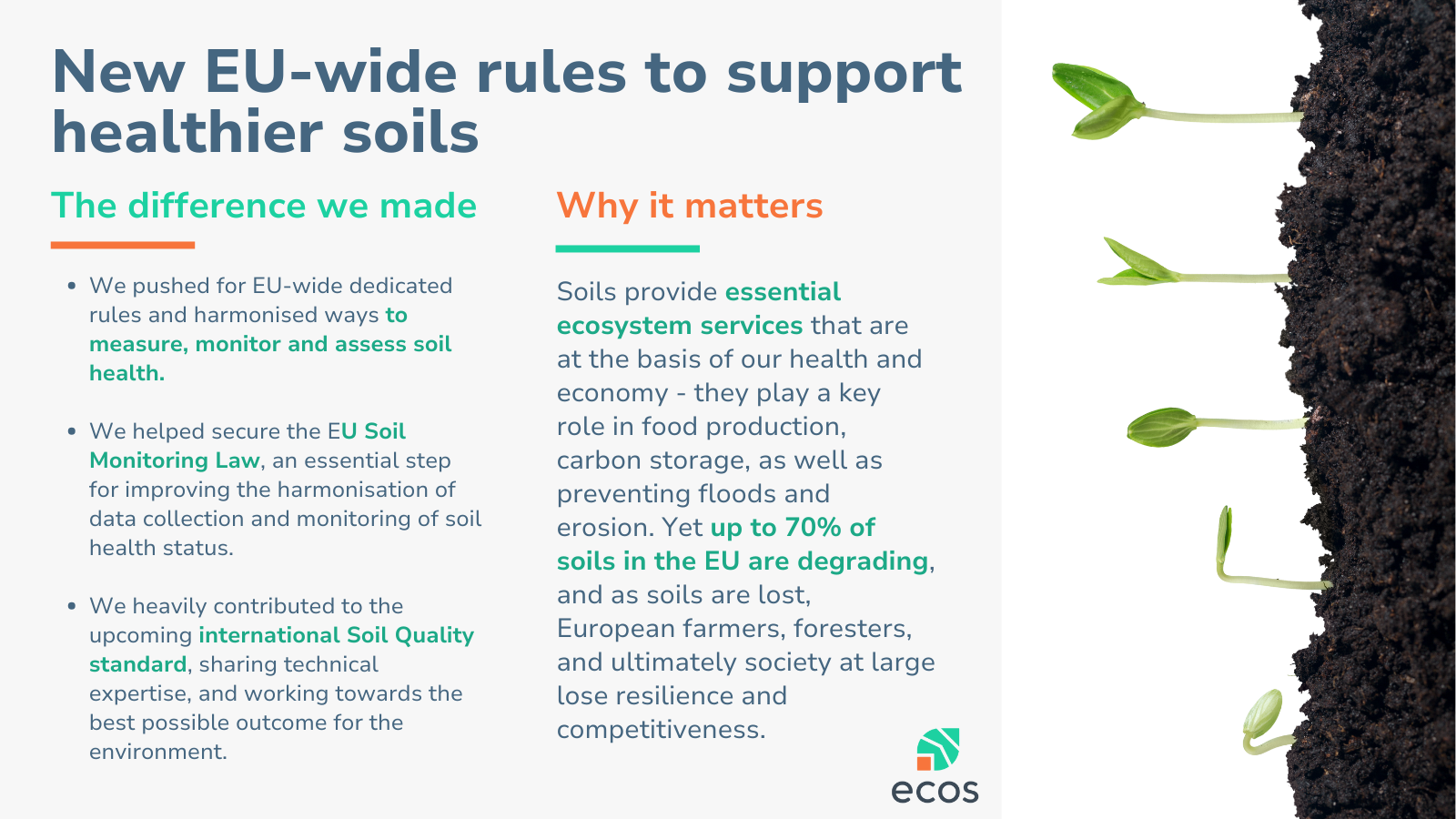
Soils provide essential ecosystem services that are at the basis of our health and economy – they play a key role in food production, carbon storage (and thus mitigating climate change), as well as preventing floods and erosion. Yet up to 70% of soils in the EU are degrading, and as soils degrade and are lost, European farmers, foresters, and ultimately society at large lose resilience and competitiveness.
To turn this around and prevent further damage, we pushed for EU-wide dedicated rules and harmonised ways to measure, monitor and assess soil health. Current measurements differ between Member States and are fragmented, incomplete, or simply missing.
By adopting the Soil Monitoring and Resilience Directive (known as the Soil Monitoring Law, or SML), the EU has taken an essential step for improving the harmonisation of data collection and monitoring of soil health status. We have campaigned for an EU-wide legislative framework: its success will depend on implementation, where standards will play an important role in ensuring consistent and measurable outcomes in protecting Europe’s soil for generations to come.
A Soil Monitoring Law grounded in technical expertise
In the midst of the current political climate of deregulation, ECOS was one of the few environmental NGOs advocating for the EU to take action and develop a legal framework to help protect soils in line with the EU Soil Strategy for 2030. We worked strategically within an informal coalition of like-minded civil society organisations, including our members European Environmental Bureau (EEB), and partners such as Pesticide Action Network Europe (PAN Europe), and ClientEarth, to raise awareness among policymakers on the crucial relevance of soils and to debunk false claims, including the myth that the SML would impose any obligations on farmers.
ECOS contributed technical expertise on the necessity for scientifically robust definitions of soil health and functions, and a broader set of soil health indicators, e.g. soil biodiversity and soil pollution. While the final text’s ambition was lower than we hoped for, with fewer obligations on soil health improvement and sustainable soil management practices – the overall outcome is a success: the EU will now collect and monitor soil health data that can drive new protection and restoration measures.
ECOS brought essential technical aspects of the law into focus, notably on monitoring and measurement. Building on our expertise in developing soil health standards, we helped ensure that the Soil Monitoring Law is rooted in solid technical grounds, ultimately securing an agreement to legislate on soils.
Our work on the EU Soil Monitoring Law ran in parallel to our ongoing contributions to standardisation developments on the international Soil Quality standard (ISO/TC 190). We were actively engaged in the drafting of two technical specifications, providing a holistic list of definitions, indicators and methodologies, as well as guidelines for the measurement of soil functions and soil-related ecosystem services.
Healthy soils are essential to all life on Earth – and ECOS will keep working towards robust policies, backed by global standards, to both protect and restore healthy soils to elevate its life-sustaining power.

