ECOS Africa: Making a greater impact
Now entering its third year, the ECOS regional office in Nairobi, Kenya is shifting from programme design to implementation, with new and expanded partnerships, projects, and topics that reinforce our work towards global standards and policies with strong environmental principles. Read on to learn how we built deeper foundations for impact throughout 2025.
We share one planet, and the imprints we make on it touch different parts of the world in different ways. From cross-border trade to climate action, waste, and pollution, regional policies can have wide-ranging global impacts. ECOS priorities reflect this, and with our offices in Brussels and Nairobi, we can be flexible, taking in the full picture and tailoring our work to different regions.
From international collaboration at the United Nations level to local actions – and everything in-between – there are opportunities to slow down the triple planetary crisis and make our shared future brighter. ECOS has over two decades of experience influencing regional and international policy and standards, which we are now channelling through our Africa and Europe offices.
What does this look like in the African region?
Partnerships are key
Strong partnerships are a key aspect of our work globally – from NGOs and environmental organisations, to industry, standardisers, and policymakers. Our goal is to nurture a more ambitious environmental agenda in a manner that is inclusive and representative of stakeholders from different regions.
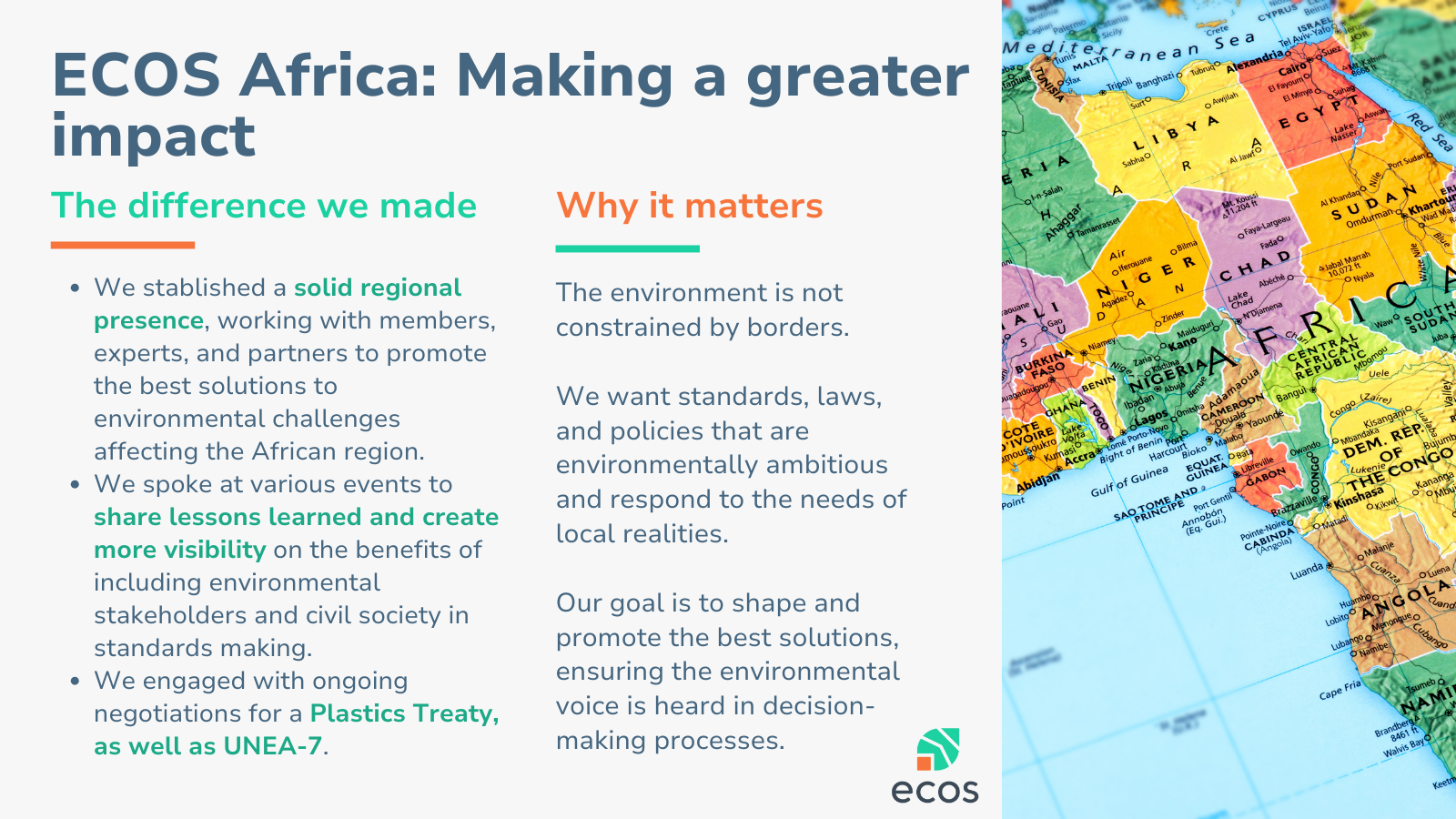
Since ECOS Africa opened its doors in 2024, it has established a solid regional presence, working with members, experts, and partners to promote the best solutions to environmental challenges affecting the African region.
2025 saw a successful conclusion of one of our first projects in the region, focused on a sector with environmental footprints across continents: textiles. 20% of the textile waste generated in the EU is traded and exported to Africa – 1.4 million tonnes in 2023. Both regions need to act to mitigate these impacts. To inform EU textile policy and waste criteria, we engaged with stakeholders from Kenyaincluding importers associations, waste handlers, and local textile recyclers and upcyclers – stakeholders who would not otherwise have been included in the process. Our work and collaboration ensured that local voices were heard,
Throughout 2025, we also grew our network. For example, by welcoming a new member from Nigeria (PAVE). We also co-hosted a joint webinar on greenwashing in Africa with our member from Cameroon (ACDESPE). This event saw more than 70 participants from across the African continent log in to hear from the Cameroonian Ministry for Environment, Protection of Nature and Sustainable Development, ANOR (the Cameroonian standardisation body), and civil society. Among other things, it highlighted why environmental stakeholders should be interested in the work of their
This year, we also implemented key objectives on our Memorandum of Understanding with the African Organisation for Standardisation (ARSO), which included engagement on and jointly celebrating the 2025 African Day of Standardisation, as well as launching mutual capacity building sessions. Together, we are working to strengthen environmental ambition and civil society participation in African continental standards.
Influencing standards
Thanks to our unique expertise and vast experience in the field, ECOS plays a critical role in shaping standards to work for the environment and advocating for more inclusion in standardisation processes. In 2025, we spoke at various events to share topical lessons learned and create more visibility on the benefits of including environmental stakeholders and civil society in standards making.
For example, we were invited to speak at the ARSO General Assembly on a panel on renewable energy, sustainability standards, and certification – our first opportunity to directly engage with African national standardisation bodies and other regional standardisation organisations on a continental platform.
We were also part of the celebrating IEC Africa’s 10-year anniversary, addressing industry leaders and innovators, government officials, policymakers, and standardisers. We highlighted how standards can respond to environmental and societal needs by spurring the transition to clean energy and supporting access to electricity.
Shaping the global policy agenda
Multilateralism is facing new challenges, with trade restrictions and international tensions rising, and a shrinking civic space. But when it comes to the environment, we live on a borderless planet, the United Nations has an important role to play. So do the many civil society organisations, including ECOS, that contribute to UN resolutions, making them more democratic, participatory, and inclusive of all voices.
In 2025, we engaged with ongoing negotiations for a Plastics Treaty, a process born from a 2022 UN Environment Assembly (UNEA) resolution. We also worked alongside other NGOs at UNEA-7, the world’s highest environmental decision-making body, to monitor and contribute to new resolutions that will shape international environmental action – for example on AI and chemicals.
The UNEA-7 resolution agreed on AI is particularly momentous because the UN Environment Programme ( , providing a platform to collate environmental knowledge on the topic, share best practices and provide technical assistance and guidance – especially to developing countries. ECOS has long identified this as a priority, with a report published on the environmental impacts of data centres in 2025. We continue to push for a more sustainable digital transition as policymakers begin to catch up.
Expanding our areas of focus
From greenwashing to electricity, textiles to e-waste, trade to AI – ECOS Africa is growing to encompass more projects and topics every year. We are just starting work focusing on the decarbonisation of the built environment via policies and standards on cement and concrete.
There is more to come in 2026. Make sure to sign up for our newsletter to see what ECOS Africa does next!

