Addressing biodiversity with standards
Companies are increasingly beginning to address their impact and reliance on biodiversity, typically through the use of standards – but their actions do not take place in a vacuum. As one of the very few civil society voices active in the development of biodiversity standards, in 2025 ECOS ensured that the frameworks being used support consistency between biodiversity goals and wider corporate sustainability strategies, working towards societal and environmental goals.
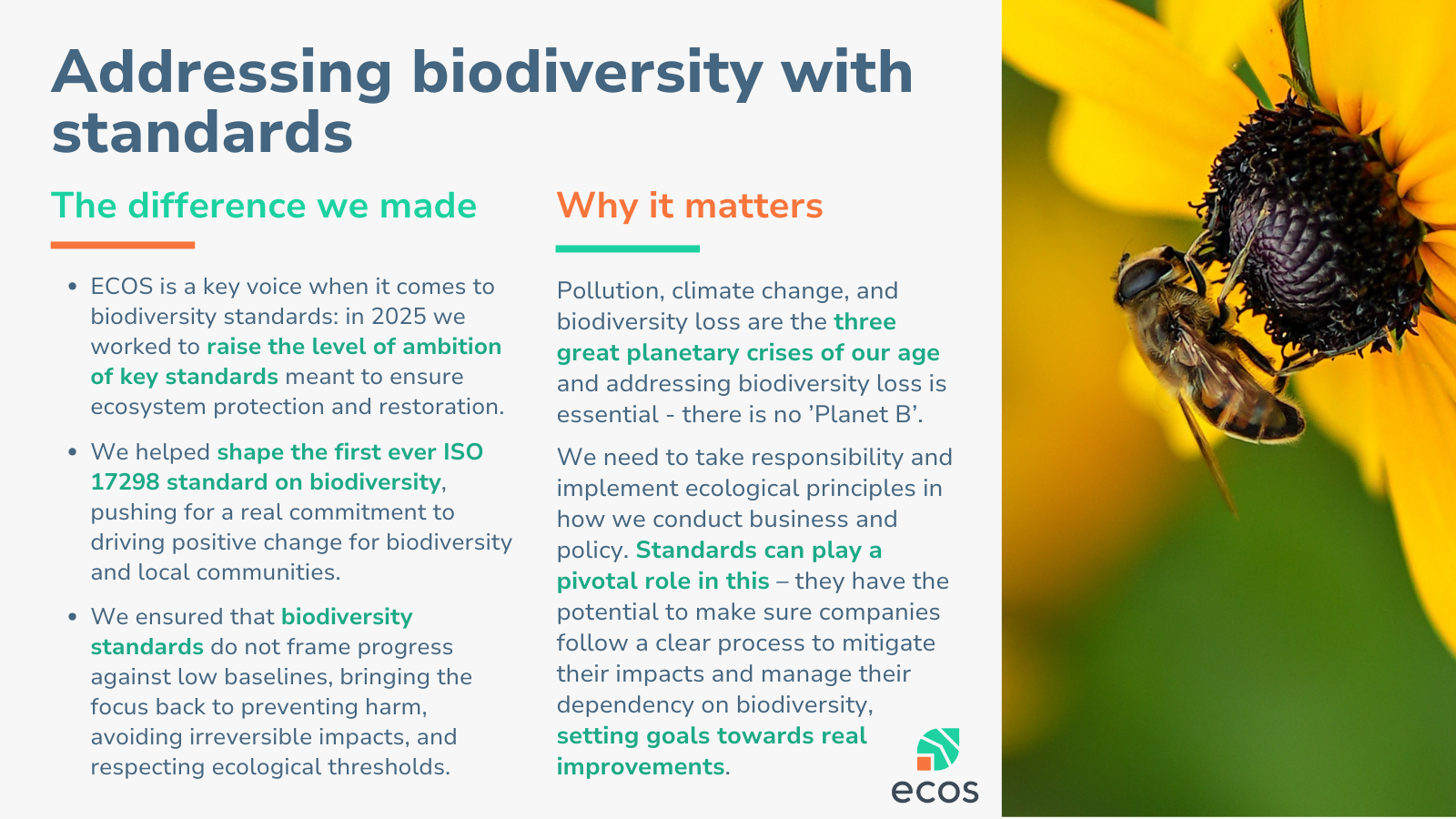
Pollution, climate change, and biodiversity are the three great planetary crises of our age and addressing biodiversity loss is essential – there is no ’Planet B’. Plants, animals, fungi, and micro-organisms not only have an inherent right to exist, but their survival directly supports our food security as well as our biological and material needs. To protect this right, we need to take responsibility and implement ecological principles in how we conduct business and policy. Standards can play a pivotal role in this – by providing guidelines and rules for implementing public policy and private sector action, but also separating good ecological conduct from greenwashing.
The United Nations Convention on Biological Diversity adopted a new Global Biodiversity Framework (GBF) in December 2022, setting high-level goals with the aim to halt and reverse biodiversity loss. National and regional governments (including the EU) are developing strategies and laws to align with the GBF, but voluntary standards, such as ISO, can already provide the framework for companies to contribute to biodiversity goals.
While some standards already address carbon emissions and removals, we need to close the gap on nature and go beyond carbon, by accounting for impacts on ecosystems and how to increase their non-carbon benefits such as providing fertile soils and habitats for key species, or mitigating flood risk.
ECOS plays an essential role in bringing the right expertise to the relevant standardisation committees and creating environmental safeguards against greenwashing. Without our involvement, biodiversity standards would be more likely to legitimise unambitious business-as-usual practices.
Standards can provide the blueprint for good ecological conduct
Corporate action on biodiversity can often follow trends, but it is not always clear if terms such as ‘nature positive’ are just buzzwords or actual commitment, supported by impactful action. ECOS is a key voice in the process: we hold standards up to the level of ambition needed to ensure that they truly support ecosystem protection and restoration. As the only NGO involved in these processes, ECOS increases credibility and trust in these new biodiversity standards and creates synergies with emerging policies such as the EU Nature Restoration Regulation, the Biodiversity Strategy for 2030, and the broader environmental acquis.
Standards can support companies in taking meaningful action on biodiversity by providing guidelines or reporting accountability. ECOS has provided science-based insight to the development of ISO biodiversity standards, so that they include key ecological principles for biodiversity protection and restoration as well as respect towards indigenous peoples and local communities.
Our work was key to ensure that standards do not become mere marketing tools, but real environmental benchmarks that support comparability of results, effective project planning and decision-making where economic activities impact or depend on ecosystems.
The first ever ISO standard on biodiversity, ISO 17298 published in 2025, was meaningfully shaped by our contributions. This year we also worked on other ISO biodiversity standards, collaborating with experts and standardisers (notably the French National Standardisation Body AFNOR), and bringing valuable expertise to the discussions.
We translated complex environmental science into concrete technical requirements, ensuring their relevance and alignment with wider sustainability goals. Without our involvement, these standards would have been more likely to prioritise easy-to-meet requirements for companies instead of true environmental gains coming from a holistic review of impacts and dependencies, and a real commitment to driving positive change for biodiversity and local communities.
ISO 17298 sets the bar for accountability through reporting on a company’s approach to biodiversity, their plan, and their impacts. Using this standard, companies can follow a clear process to mitigate their impacts and manage their dependency on biodiversity, setting goals towards real improvements.
We also helped shape the ambition of another important standard: ISO 17620, which relates to the emerging concept of ‘biodiversity net gain’ and sets guidelines and requirements on what constitutes good biodiversity protection and compensation measures. This standard is typically used in land development projects that impact biodiversity and strictly follows the established concept of ‘mitigation hierarchy’ – a sequence of actions which anticipate and avoid biodiversity impacts and ecosystem services. Where impacts cannot be avoided, actions are taken to minimise these impacts and to rehabilitate or restore lost biodiversity. When significant residual impacts remain, all impacts on biodiversity should be offset from land development.
Every biodiversity standard is different, but the underlying goals and challenges are often shared. A core challenge is ensuring that standards can detect meaningful changes in biodiversity outcomes, whether positive or negative, rather than making it easy to conclude that “everything is improving.” ECOS ensured that standards do not set the bar low and frame progress against already degraded baselines. Instead, we bring the focus back to preventing harm, avoiding irreversible impacts, and respecting ecological thresholds.
What happens next?
In 2026, ECOS will contribute to the development of new standards on biodiversity monitoring, particularly to assess the impacts of forestry on forest ecosystems and other human-related activities and ecosystems. This work will support the implementation of high-level goals from the UN Global Biodiversity Framework and EU policies such as the Nature Restoration Regulation.

