Making ecodesign a success in Europe
At the beginning of 2025, ECOS was appointed a member of the EU’s Ecodesign Forum, and we wasted no time in working to fulfil the potential of this new and ambitious piece of EU legislation, which holds the key to pushing polluting goods off the market. Mandating manufacturers to consider the environment when designing their products for the EU market will have a wide-reaching impact on global value chains.
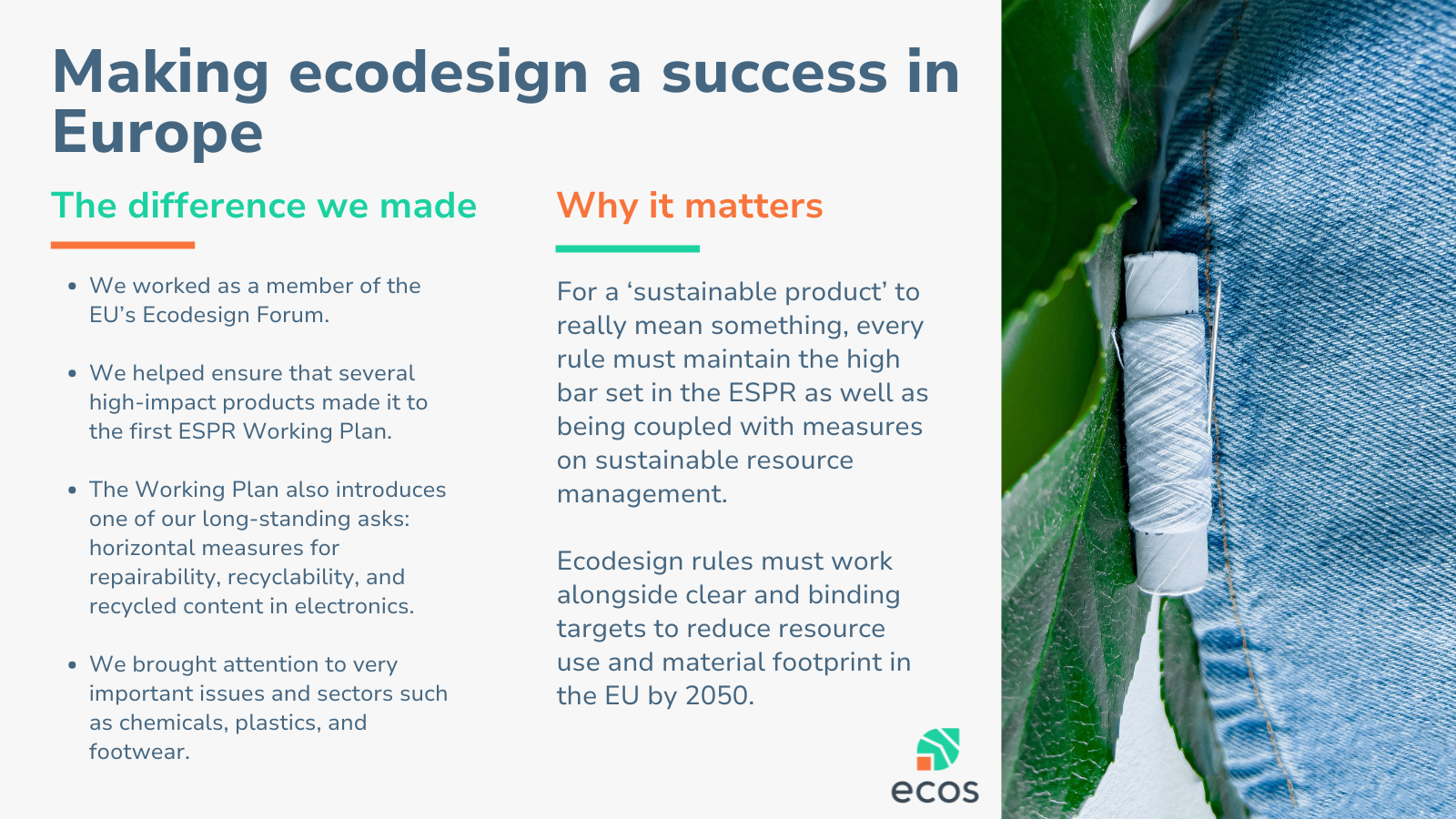
In 2024 we celebrated the arrival of the ecodesign revolution in Europe. Making sustainable products the norm has been a long-standing priority for ECOS, and the EU’s Ecodesign for Sustainable Products Regulation (ESPR) is a huge step towards this goal. The ESPR lays important groundwork to reduce wasted resources and limit the impact that products have on the environment at every stage of their lifecycle – helping make short-lived, disposable, unrecyclable, and unrepairable items a thing of the past.
Expansive and broad reaching EU ecodesign rules
ECOS successfully campaigned to extend the EU’s ecodesign framework to all products – the ESPR is an expansive piece of EU legislation that will eventually apply to most products on the EU market. The first working plan, published in April 2025 includes several of our top priorities; it will cover the first five years of ESPR implementation and effectively prioritises which products and sectors will be addressed first.
ECOS helped ensure that several high-impact products we included in the priority list and kept attention on two other sectors with great environmental footprint – footwear and chemicals, which are also featured in the ESPR working plan as areas of further study. We also successfully demonstrated the value and positive impact of horizontal measures to policymakers, which will support reuse, repair, and a more circular economy.
Though we wanted a longer list, the current working plan is a positive step and will allow policymakers and stakeholders to focus on products and measures for an ambitious outcome.
Making ecodesign work in Europe
Implementing new ecodesign rules will require a multi-faceted approach to deal with the environmental impact of all of these products; it is important to address as many as we can, as quickly as possible. We called on EU decision-makers to include as many sectors as possible so that the work can begin as soon as possible, and in the end the first working plan strikes a good balance by including a wide variety of products with a large impact and capacity to be improved through ecodesign.
Textiles, tyres, furniture, and mattresses are now prioritised, alongside two intermediate products with a significant environmental impact – aluminium and steel. The first working plan also introduces horizontal measures for repairability, recyclability, and recycled content in electronics, something we first called for in our 2023 letter to the European Commission.
“The product-by-product approach taken so far has led to some important achievements, but we urgently need to switch gears. We won’t be able to confront the world’s growing e-waste problem unless we act fast – and that can only happen if the Commission starts dealing with similar products at the same time.” – ECOS Press Release, April 2025
In 2025 we also saw results from our continued campaigning with the Rethink Plastic alliance for ecodesign for plastic. The first ESPR working plan now studies to support further ecodesign work on chemicals and plastics, as well as footwear – important sectors that had been overlooked thus far. And we did not achieve this alone – we worked with our broad network, informing and leading civil society efforts to ensure impactful results.
We will continue to advocate that plastic – is addressed as soon as possible in subsequent ESPR working plans or when sector-specific legislation fails to deliver, that the ESPR can .
Ecodesign will underpin a competitive, resilient, and circular EU economy
The ESPR will show that the value of making design choices based on environmental considerations is self-evident. Sustainability must be built into a product’s whole lifecycle already during design phase – and this regulation will make this happen on an extensive, unprecedented scale, contributing to the EU’s climate and energy goals, and help build a competitive, circular economy.
Every sector covered by the ESPR will have Delegated Acts that are developed by the European Commission, with advice from the Ecodesign Forum – a diverse group of experts that includes civil society, Member States, industry, and recyclers. With a long history and expertise in ecodesign, ECOS is an active member of this group, and we are working closely with our members, partners, and other Forum participants.
For a ‘sustainable product’ to really mean something, every rule must maintain the high bar set in the ESPR as well as being coupled with measures on Ecodesign rules must work alongside clear and binding targets to reduce resource use and material footprint in the EU by 2050. We are looking forward to continuing this work in 2026!

